Jul 29, 2026-Reviews

Postiv AI Review - A Content System, Not a Post Generator
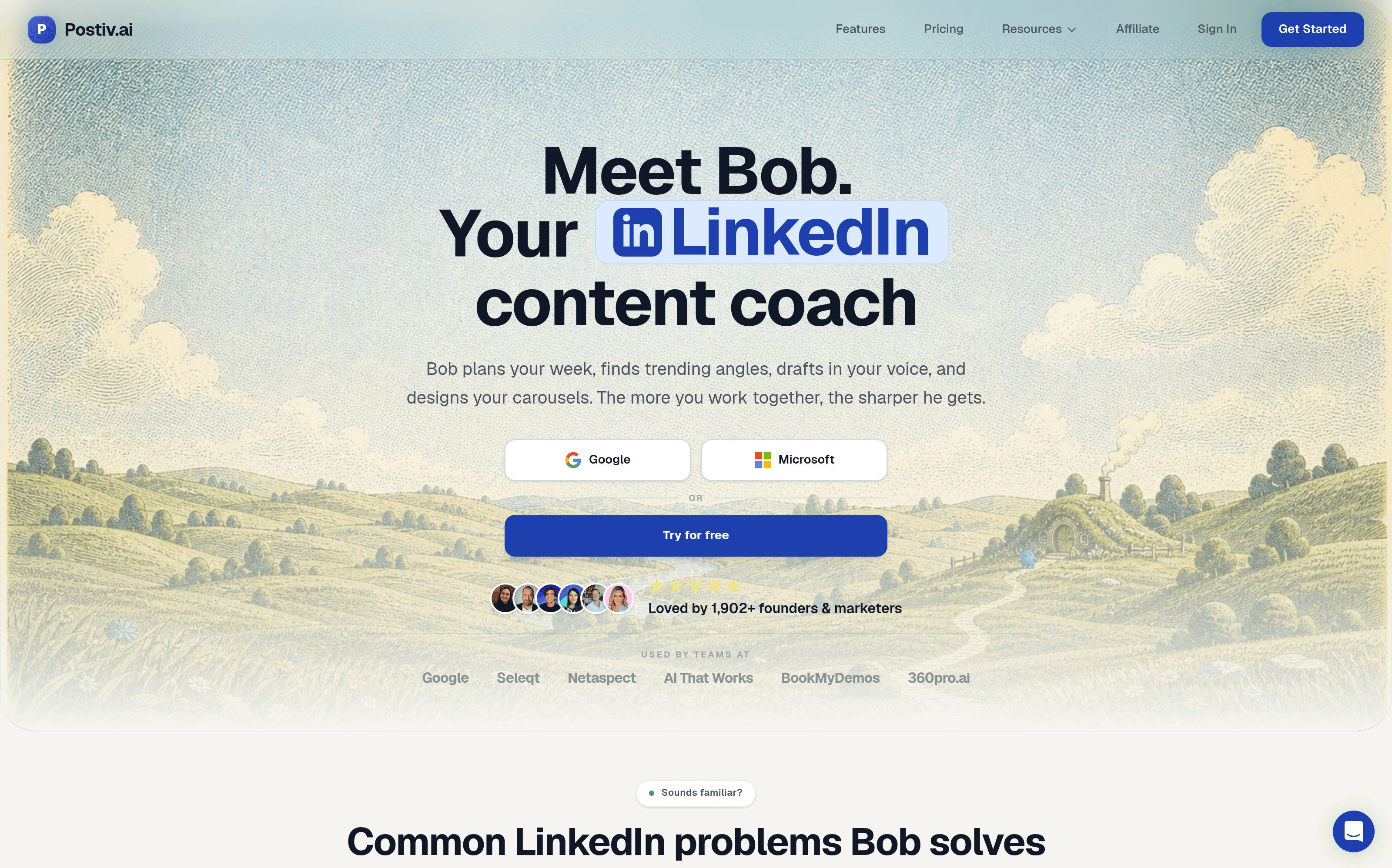
We've tested Postiv AI, a LinkedIn content system that turns your pillars into a weekly plan, drafts and carousels, and feeds performance back into next week's briefs.
Welcome to this Postiv AI (postiv.ai) review ✨
Everyone knows the LinkedIn advice by now. Post consistently. Have a point of view. Do more of what works. The advice isn't the problem. The problem is that consistency is an operational task disguised as a motivational one: it needs a topic list, a calendar, a drafting habit, and someone actually reading the numbers afterwards. Most of us have two good weeks, then a client lands, and that's that.
So the interesting question about any LinkedIn AI tool isn't "can it write a post." Of course it can write a post. ChatGPT can write a post. The question is whether it can hold the system — the pillars, the weekly plan, the loop back from performance into next week's topics — so that showing up doesn't depend on you being motivated on a Monday morning.
That's the claim Postiv makes, and it's the one I set out to test. Carolina Posma and Jan van Musscher built it out of Carolina's own LinkedIn workflow, and the whole product is organised around a character called Bob, pitched not as a writer but as a coach. I signed up on the 7-day trial, connected my real LinkedIn account, and ran a full cycle on my own business: define pillars, plan the week, draft a post, turn it into a carousel, and try to close the loop with analytics. Here's what happened.
Getting in: an onboarding that does the reading for you
Signup is a chat with Bob rather than a form, and the small detail that got my attention is that it arrives with the answers already filled in. It asked for my LinkedIn URL and the field was pre-populated with my actual profile. It asked for my company website and had already worked out uneed.best. It asked me to confirm the organisation name and had typed "Uneed."
Then it asked the one thing it couldn't infer: what I actually want out of LinkedIn. I told it I want to grow Uneed by sharing what I learn building an indie Product Hunt alternative. It asked which days I aim to post — Mon/Wed/Fri at 09:00, with an explicit note that this is a goal, not an automation, and that nothing gets scheduled or published without me. Then team size, then LinkedIn.
The LinkedIn connection is the part people are rightly nervous about, and Postiv addresses it head-on in the flow: it uses LinkedIn's official OAuth, the same route Buffer and Hootsuite take, and the copy points out that account bans come from unofficial tools that scrape the site or ask for your password. There's no Chrome extension anywhere in this product. Worth noting too: the trial started without a card. I never entered payment details at any point.
Two minutes in, I had a workspace. What I didn't have yet was a system — and that gap is the honest part. Postiv's home screen immediately told me Bob was "2/3 done" and pushed me to add a knowledge source. I pointed it at uneed.best with an include path of /blog/*.
By the time I'd looked at three other screens, it had crawled the site, extracted 20 assets into what it calls Bob's memory, and — more usefully — written a 1,425-character description of Uneed into the Foundation. That description was correct in a way that surprised me. It knew about the 64,000-member community, the guaranteed homepage visibility for launches, the DR 75 backlink, the daily competition model with badges for the top 3. Nothing in there was invented.
Foundation: where the strategy actually lives
Foundation is the settings screen that matters, and it's split in two: an Organization Foundation shared across everyone in the workspace (business description, language, audience, competitors) and a Profile Foundation per LinkedIn profile that inherits from it. If you're running a team, that inheritance is the whole point — the company facts are written once, and each person's voice and goals sit on top.
Per profile you set a content goal (thought leadership, lead generation, talent, or a custom one), your posting cadence, and your content pillars — up to five, described as "the topics you want to be known for." Underneath sits the voice layer: an "Extract Style" button that learns from your imported LinkedIn posts, an option to upload writing samples instead, a Saved Memory panel where Bob records preferences you state in chat ("never use hashtags"), and a free-text Custom Instructions box that overrides the learned style.
The pillars start empty. Postiv doesn't guess them for you at signup, which I think is the right call — but it does mean the strategy layer is opt-in, and it's the step a hurried user will skip. The home screen nudges you toward it with a card that reads "Your pillars are ready to define," and a button labelled Build with Bob.
Pillars: the part I expected to be generic
I clicked Build with Bob expecting three bland categories. What I got instead was a visible research pass. The trace showed it reading an internal playbook called "LinkedIn Pillar Strategy," running an account action, noting honestly that it had analysed 0 posts by engagement because no analytics were connected yet, then searching its knowledge for "Uneed product launches indie m…", "Thomas Sanlis building in publ…", and "Writizzy blogging platform Saa…".
Its reasoning, which it shows you as it goes, concluded: I'm running three things at once, and I already post real numbers. Then it proposed three pillars, each with a structure I hadn't seen in a tool like this — an Exists to, a Why you, and a set of Angles tagged by type:
Building Uneed in Public — Exists to: drive makers to launch on Uneed and build your authority as its founder. Why you: you're the one running the platform and posting the actual traction (180K product clicks, 6,400 submissions, 64K+ member community). Angles: monthly stats drops (proof), launch war-stories/community feedback (story), what makes a launch actually get traction (teach).
The other two were Indie Hacker Money Diaries and Building Writizzy in Public. It cited my $134K in 2025 and $250K 2026 target, the 97K unique visitors and $28K in 30 days, and my 450+ member French indie hacker community. All of that came from my actual posts and site, not from a template.
The confirmation step is a small piece of interaction design worth calling out: rather than a free-text "does this work?", it gives you numbered options — Yes, save these / Close, but tweak one / Want a different direction / Something else — plus Skip and Confirm. One click and it reported "Created 3 pillars," mapped one to each of my Mon/Wed/Fri slots.
That mapping is the hinge of the whole product. From that point on, every empty slot in the week already has a topic attached to it.
The weekly plan: slots, not a blank page
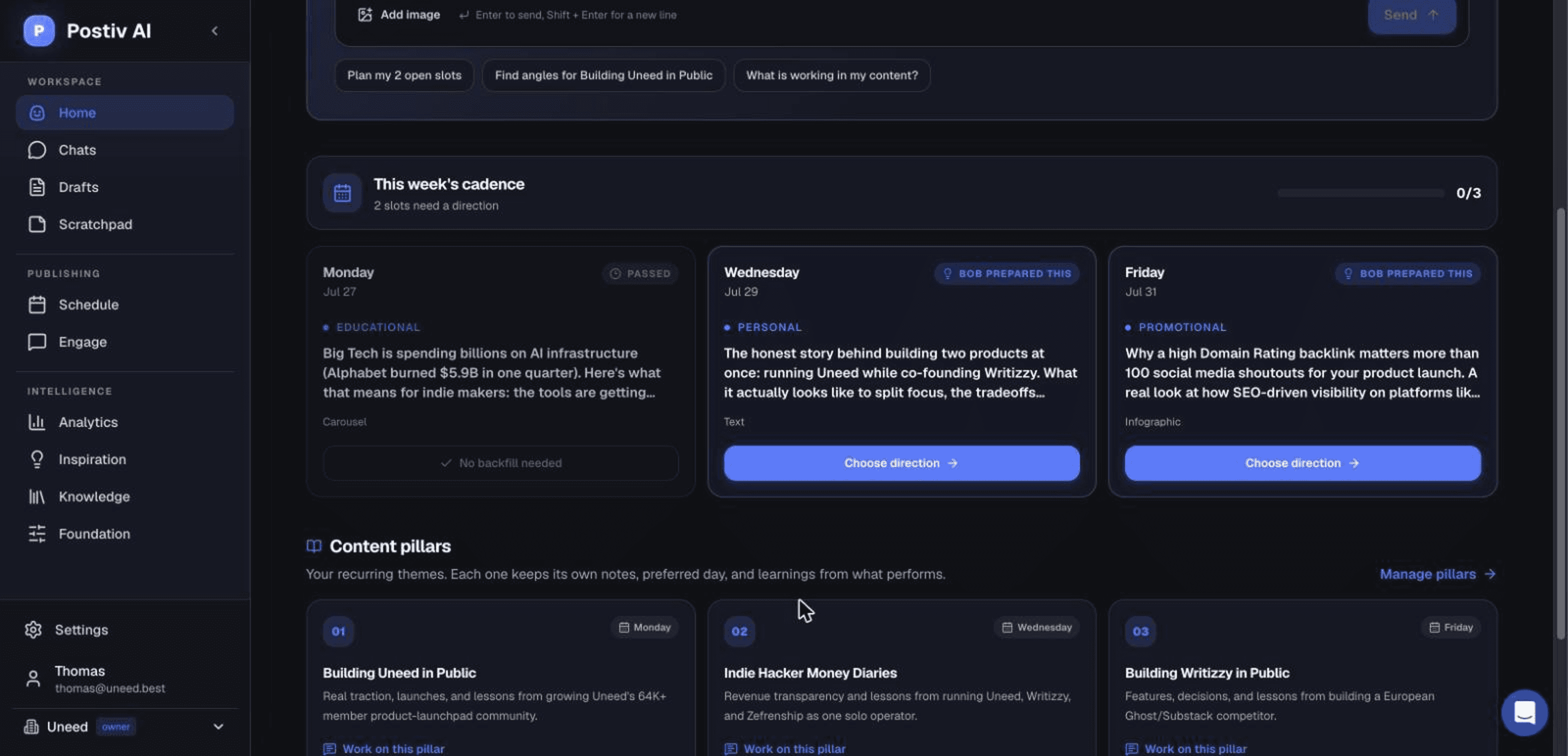
The home screen is titled Bob's Weekly Desk, and the subtitle is a fair description of the intent: "Turn your strategy into a finished week." It shows the current week (Jul 27 – Aug 2 when I tested), a cadence tracker reading 0/3 with "2 slots need a direction," and one card per posting day.
Monday was marked PASSED with "No brief attached to this slot" and, sensibly, "No backfill needed" — it doesn't guilt you about a day you can't recover. Wednesday and Friday sat there as OPEN SLOT, each reading "Ready for Bob to find the right direction," with a Fill this slot button. Three shortcut chips sit above: Plan my 2 open slots, Define my content pillars, and What is working in my content?
This is the difference between a generator and a system, and it's mostly a UI difference rather than a model one. A generator gives you a text box. Postiv gives you three named holes in a calendar, each already tied to a theme, and asks which one you want to fill.
It also fills them in on its own. I went off to look at other screens, and when I came back to the desk both open slots were tagged BOB PREPARED THIS with a brief waiting in each — Wednesday marked PERSONAL and suggested as a Text post ("the honest story behind building two products at once"), Friday marked PROMOTIONAL and suggested as an Infographic (why a high Domain Rating backlink beats a hundred social shoutouts). The button on each had changed from "Fill this slot" to Choose direction. Neither brief was a topic I'd have picked, and both were things I could genuinely write.
Drafting: fast, in-voice, and in need of a fact-check
I asked Bob to fill Wednesday from the Uneed pillar and gave it a real angle: we passed 6,400 submissions and I had to build an AI triage step because I couldn't review them all by hand. Keep it honest, no hype.
About thirty seconds later a post editor opened on the right, rendering a live LinkedIn preview complete with my name, my headline, and toggles for Desktop and Mobile. A character counter read 1368/3000, an autosave indicator said Saved, and a small chip showed which pillar the draft belonged to. In the chat, Bob wrote: "Drafted and linked to your Building Uneed in Public pillar. That's Wednesday's slot filled — want to line up Friday's Writizzy post next?"
The draft itself opened like this:
6,400 product submissions wasn't the problem. Reviewing them all myself was.
It was good. Short paragraphs, no hashtag soup, no "Here's what I learned 👇", and it held the ambivalence I'd asked for — including a line about hesitating to let a model near a process that's supposed to give makers real feedback. If you'd told me a person wrote it, I'd have believed you.
But it also wrote that the review load "stopped making sense" after 5,000 submissions a month. I never said that. 6,400 is a lifetime total, not a monthly rate, and Postiv invented the monthly figure to make the paragraph land. That's the honest catch with every tool in this category and it's worth stating plainly: the drafts are good enough that you will stop reading them carefully, and that is exactly when a made-up number goes out under your name. The invented figure also propagated — when I turned the post into a carousel, it became slide 3.
Carousels: branded without a brand kit
From the same editor there are four buttons under the draft: Generate Image, Generate Carousel, Generate Infographic, Attach Existing. I hit Generate Carousel, which pre-fills the chat with "Please turn this post into a carousel."
It took about ninety seconds — the slowest thing in the product by some margin — and produced seven slides. Slide one read "6,400 submissions. One founder. A hard call." under a FOUNDER JOURNEY eyebrow; slide two was tagged THE OLD WAY. What I didn't expect was that it had already picked up Uneed's branding: the logo sits top-right on every slide, the accent colour is Uneed's orange, and each slide carries my avatar with "Follow for more insights." I never uploaded a logo or set a colour.
The editor gives you Export PDF, Add Image, per-slide editing, horizontal and vertical views, and a Styles panel. That panel is the interesting bit for teams: it starts empty ("No saved styles yet") because styles in Postiv aren't templates you configure up front — you generate a carousel you like, save it as a style, and every future carousel inherits it. There's a checkbox to push a saved style to every profile in the workspace.

The Scratchpad, and the moment the system clicked
The Scratchpad is a small feature and my favourite thing in the product. It's a pinboard described as "raw material for Monday's plan," and items fade after 30 days. The pitch is that you drop things there mid-week — a link, a screenshot, half an idea — and Bob pulls from it when planning.
So I tested exactly that. I dropped in a note: a founder emailed to ask why his tool was rejected, the decline reason was too vague, maybe worth a post about writing rejection emails people can act on. Then I asked Bob to plan Friday's open slot and check the scratchpad first.
It read the note — the trace showed View Scratchpad, and the item rendered inline in the conversation as a card. And then it declined to use it:
Heads up: your scratchpad note (vague rejection emails) fits Uneed's Monday pillar better, not Friday's Writizzy slot — I've saved it for later and pulled three fresh Writizzy directions instead. Pick one to draft.
It then gave me three Writizzy angles, each labelled Teach, Opinion, and Proof, one of which was a genuinely sharp positioning line about Ghost never having been built for writers outside the US and UK.
That's the whole argument for a content system in one interaction. A generator would have taken my note and written the post I asked for. Postiv checked it against the pillar assigned to that day, decided it belonged somewhere else, filed it, and proposed alternatives that fit. It said no to me, correctly.
Analytics: the leg that isn't finished yet
This is the part of the loop I can't report as working, and I'd rather say so than paper over it.
Analytics carries a Beta badge, and the dashboard is gated behind a one-time import of 12 months of LinkedIn history. I started the import. It ran for a while showing "Bob is backfilling your analytics," then flipped to Retrying: "One of your accounts did not finish importing its history. We are keeping the dashboard hidden for now so you only ever see complete numbers, not a half-finished view." It never completed during my session.
Two things are true at once here. The failure handling is unusually mature — it refuses to show you a partial dashboard, it retries on its own, and it promises an email when it's done rather than asking you to sit and refresh. And a fresh account on day one simply does not have the third leg of the loop. Bob was upfront about it too, telling me during the pillar work that with no analytics connected it was treating my past posts as voice evidence, not performance data.
So the improvement loop is real in design — pillars carry their own "learnings from what performs," the chip on the home screen literally asks What is working in my content?, and next week's briefs are meant to build on your best posts — but I can only vouch for the first two thirds of it from a week-one account. If you're evaluating Postiv specifically for the analytics feedback, budget a few weeks of posting before you judge it.
The rest of the intelligence layer works today. Inspiration is a searchable library of what's currently performing on LinkedIn — 7,223 posts when I looked, filterable by creator, by type (educational, promotional, personal), by format, and sortable by virality, each with a "Use in post" button. Engage puts comments on your posts into a single inbox with Bob suggesting replies in your tone, and a Feed tab where you build lists of profiles you want to engage with regularly.
Everything else in the box
- Knowledge sources that keep themselves current: website crawls with include/exclude path rules, YouTube transcripts, Notion pages, competitor LinkedIn profiles, an API, and a dedicated
@sources.postiv.aiaddress you forward newsletters to. - Comment Plug — an automatic first comment on your posts, minimum 15 minutes after publish, with up to five variants picked at random or by context-aware routing using "use this when…" hints you write yourself.
- Scheduling on a week or month planner, with approval workflows for teams and a Post History view.
- A LinkedIn MCP server at
postiv.ai/mcpexposing 25 tools — search knowledge, draft, generate carousels, schedule, read analytics — to Claude, ChatGPT, Cursor, n8n and the rest. Notably,schedule_postalways queues; nothing publishes straight from an agent. - Company page posting, team workspaces with streaks and leaderboards, and post-publication webhooks (also in beta).
Pricing
Postiv sells one product with everything in it, and prices per seat rather than per feature. Pro is €99/month for a single creator and includes the writer, carousels, scheduling, analytics and engagement — there's no cheaper tier that strips the system down to a generator, which is consistent with the positioning but does make it a real commitment for a solo founder. Team Light is €229/month for three LinkedIn seats, which works out at €76 a seat, roughly 23% off, and adds collaborative workflows, approvals and a shared asset library. Above that, Enterprise is custom-priced with unlimited seats and dedicated onboarding, and there's a separate Agency Partner track with white-label reporting for people running many client brands.
Every paid plan opens with a 7-day free trial, cancel anytime, and — worth repeating since it's rarer than it should be — no card is required to start it. My settings page showed "Pro Plan · Trial, 7d left · Then EUR 99/month" without me having entered any payment details.
Who should use Postiv?
It's a strong fit if you are:
- A founder or consultant who has decided LinkedIn matters, has tried and stalled, and wants the operational scaffolding rather than another blank prompt.
- Someone with real material — numbers, launches, opinions — that you're not turning into posts because the packaging is the bottleneck.
- A team lead trying to get five people posting from one workspace with shared brand facts, per-person voice, and an approval step.
- An agency or an operator already running an AI workflow who'd rather drive content through the MCP than another dashboard.
It's probably not for you if you just want a post written now and then. €99/month is a lot for that, and the pillars, cadence and knowledge sources are overhead you'd never use. It's also not the right buy today if the analytics loop is the only reason you're interested — that part is still in beta.
Conclusion
That's the end of this Postiv AI review. The thing I keep coming back to is the Friday slot. I handed Bob a note and asked it to use it, and it told me the note belonged to a different day and gave me three better options instead. Nothing about that is impressive as a language-model trick. It's impressive because it means the pillars, the calendar and the scratchpad are actually wired to each other — which is the entire difference between a content system and a content generator, and the reason most people who buy a generator stop posting by week three anyway.
The writing is good, the carousels came out on-brand without me configuring anything, and the strategy work Bob did on my business was better-researched than I expected. The honest gaps are that you must fact-check the drafts, and that the analytics half of the improvement loop wasn't available to me on a week-one account.
If you've got the material and keep losing to the packaging, the 7-day trial is enough to find out — define your pillars on day one, and you'll know by the end of the week whether the weekly desk is the thing that finally makes you show up.
What I liked:
- Pillars are a real object in the product, not a settings field — each one carries its own angles, a preferred day, and learnings from what performs.
- The weekly desk replaces a blank page with three named slots, each already tied to a theme — and Bob fills the empty ones with briefs on its own while you're elsewhere.
- Bob refused to force my scratchpad note into the wrong slot and proposed better-fitting angles instead.
- Onboarding pre-filled my LinkedIn, my domain and my company name, then crawled my site into an accurate 1,425-character business description.
- Carousels came out branded with my logo and accent colour without me uploading a brand kit.
- LinkedIn's official OAuth, no Chrome extension, and nothing publishes without approval.
- A 25-tool MCP server if you'd rather drive it from Claude, ChatGPT or n8n.
- 7-day trial with no card required.
Things to keep in mind:
- It invented a statistic in my first draft ("5,000 submissions a month") that I never gave it, and carried it straight into the carousel. Fact-check every post before it goes out.
- Analytics is in beta, and my 12-month history import failed and went into retry — the performance half of the loop wasn't usable on a fresh account.
- Carousel generation took about 90 seconds.
- Pillars aren't created for you at signup; if you skip that step you're left with a nicer generator.
- €99/month for a single seat is a real commitment, and there's no lighter tier.
If LinkedIn is on your list every quarter and never gets done, Postiv is worth the week.
Jamdesk Review - Documentation Your AI Agent Can Actually Read
We've tested Jamdesk, a documentation platform that ships MDX docs, an API playground, and a built-in MCP server so your AI agent can write and maintain the docs with you.
Fomr Review - A Free, Unlimited Form Builder for Small Teams
We've tested Fomr, a free unlimited form builder with a visual drag-and-drop editor, an AI form generator, and workflows that push responses to Google Sheets.
Related Articles